Category: Revenue & Ordering

  • Why Restaurant Owners Should Own Their Customer Data

    Why Restaurant Owners Should Own Their Customer Data

    Most restaurant owners couldn’t answer this question: “Who are your 50 best customers?” Not their names, not their contact info, not their order history. If the majority of your orders flow through DoorDash, Uber Eats, Grubhub, or OpenTable, that data belongs to those platforms — not you. This post explains why that matters, what it’s costing you, and what owning your customer data actually means in practice.


    What “Customer Data” Actually Means for a Restaurant

    When restaurant operators talk about customer data, they’re not talking about spreadsheets full of demographics. They’re talking about a specific set of operational facts that allow you to run a real marketing operation:

    • Name and contact information — email address, phone number
    • Order history — what they order, how often, average spend per visit
    • Visit frequency — how long since their last order or reservation
    • Acquisition channel — how they found you in the first place

    The contrast between platform ordering and direct ordering makes this concrete. When someone places an order through DoorDash, you receive an order number and an eventual payout. You do not receive a name, an email address, or any information that would allow you to contact that person again. When someone orders through your own website with an account, you receive a customer profile — one you can market to indefinitely, segment however you want, and build a relationship with over time.

    One of those outcomes creates a transaction. The other creates a customer. Restaurant data ownership is simply the practice of ensuring those customers belong to your business, not someone else’s platform.


    The Platform Dependency Problem

    Delivery platforms and reservation systems are built on a structural premise: they own the customer relationship, and you pay for access to it. This arrangement works until it doesn’t.

    When DoorDash changes its ranking algorithm, raises commission rates, or a competitor restaurant buys better placement, your sales can drop overnight — and you have no fallback. You can’t email your loyal customers because you don’t have their email addresses. You can’t run a re-engagement campaign to bring back regulars who haven’t ordered in two months because you have no list to reach. The business asset that should be yours — an audience that already knows your food and trusts your restaurant — is sitting in someone else’s database, accessible only as long as you keep paying the platform’s fees.

    This is not a worst-case scenario. It’s a structural vulnerability that affects any restaurant whose customer acquisition runs primarily through third-party platforms. The moment platform economics shift against you, you have no owned channel to fall back on. No email list. No SMS list. No loyalty program with real data behind it. Just a dependency on a platform that has its own shareholders and its own priorities.

    OpenTable creates the same dynamic in reservations. When guests book through OpenTable, they’re OpenTable’s users. You get a reservation on your sheet. They get the customer relationship.


    What You Can Do With Customer Data You Own

    Owning customer data is not an abstract concept — it’s a set of specific revenue-generating capabilities that become available to you. Here’s what that looks like in practice:

    • Email campaigns for new offerings: “We’re launching brunch this Saturday — here’s 15% off your first order.” Sent to customers who’ve already ordered from you and liked it enough to give you their contact information.
    • Re-engagement campaigns: Identify every customer who hasn’t ordered in 60 days. Send a win-back offer. Many of those customers didn’t leave because they disliked you — they just forgot, or got into a routine with something else.
    • Loyalty programs that actually work: Points, rewards, and birthday offers all require knowing who your customers are. A loyalty program with no customer identity behind it is just a punch card.
    • Targeted upsell campaigns: Customers who order pizza regularly receive a message about your new pasta dishes. Customers who order appetizers get an invite to a tasting event. Segmentation based on order history is only possible when you own that history.
    • Post-order feedback loops: Send a survey to customers who ordered a new menu item last week. Find out what landed before you commit to keeping it on the menu.
    • Event promotion to a warm audience: Announce a wine dinner, a live music night, or a holiday menu to customers who’ve already dined with you. Your conversion rate will be significantly higher than any cold advertising.

    Consider the economics of re-engagement alone: A re-engagement email sent to 500 customers with a 10% conversion rate at a $35 average order value generates $1,750 in revenue from a single email. That math requires owning 500 email addresses. Without them, the campaign doesn’t exist.

    None of these capabilities require a sophisticated tech stack. They require one thing: a list of customers you actually have permission to contact.


    How Platforms Deliberately Prevent Data Ownership

    This is not a gap in how platforms operate — it is the policy. DoorDash, Uber Eats, and OpenTable Terms of Service explicitly prohibit restaurants from using customer data collected through their platforms for independent marketing purposes. The contact information collected during a transaction on their platform belongs to them, not to you.

    This is structural, intentional, and designed to maintain platform dependency. If you could take DoorDash customers and move them to direct ordering — even gradually — you’d reduce your reliance on DoorDash. That is precisely what the Terms of Service prevent. The platform retains the customer relationship, you receive the order fulfillment work, and the commission keeps flowing.

    Understanding this as deliberate policy, rather than an accidental side effect, is important. It means the only way to build customer data you own is to create direct channels that bypass third-party platforms entirely — or that run alongside them while systematically converting platform customers into direct customers over time.


    Find out if your website is capturing customer data — or giving it to the platforms.
    Free audit — checks direct ordering setup, customer data capture, and your ability to market to past customers.

    How to Start Building Customer Data You Own

    The good news is that building an owned customer list does not require abandoning delivery platforms overnight. It requires adding direct channels that capture customer data at every opportunity. Here are the most practical starting points:

    1. A direct ordering website with customer account creation. Every order placed through your own website builds your list. Customer name, email, and order history are captured automatically. This is the highest-volume data collection point available to most restaurants.
    2. WiFi sign-in capture. Restaurant WiFi that requires an email address to connect is a low-friction way to collect contact information from dine-in customers. Most guests will enter an email to get internet access without thinking twice.
    3. A loyalty program with email or phone enrollment. Even a simple punch card, digitized with a signup form, converts dine-in customers into reachable contacts. The incentive to join is built into the program itself.
    4. A reservation system you control. Direct reservation tools — not OpenTable — capture the guest’s contact information in your system. If a guest books directly through your website, that contact information is yours to keep and use.
    5. A post-dining receipt with a QR code. A printed receipt or table card linking to a feedback or signup page catches guests at the moment they’re most likely to engage. A simple form — name, email, feedback — converts a transaction into a data point.
    6. In-store sign-up offers. “Join our list and get a free dessert on your next visit” is a straightforward exchange that works at point of sale, on table tents, or on a chalkboard near the door. The barrier to entry is low, and the incentive is immediate.

    None of these approaches requires significant upfront investment. Most can be implemented incrementally, alongside existing platform operations, while gradually shifting the balance toward direct customer relationships.


    The Long-Term Asset Value of an Owned Customer List

    A restaurant with 2,000 email addresses and a documented order history is a fundamentally different business than one without. That list is reachable on demand, marketable at near-zero cost, and recoverable if a platform changes its terms, raises its fees, or shuts down a market entirely.

    It is also an asset that compounds. Every direct order adds a new customer profile. Every email campaign builds the relationship and teaches you more about what your customers want. Every re-engagement that brings someone back adds another data point and another order to that customer’s history. Over time, the list becomes an increasingly accurate picture of who your best customers are, what they order, and when they’re likely to order again.

    Contrast that with platform dependency, where your customer relationships reset to zero if you leave the platform, and your marketing capability is entirely a function of what the platform chooses to offer you. The restaurant that owns its customer data has leverage. The one that doesn’t is always one algorithm change away from a revenue problem it cannot solve on its own.

    Restaurant data ownership is not a technical initiative. It’s a business strategy. The restaurants that understand this early will be better positioned for every change in the delivery and reservation platform landscape that follows.


    How RichMenu Approaches Customer Data Ownership

    RichMenu builds direct ordering websites where every order creates a customer record you own. Customer name, email address, and complete order history are captured automatically and belong to your restaurant — not a platform. The infrastructure is designed from the ground up for turning first-time orders into long-term customer relationships, giving you the data foundation that loyalty programs, re-engagement campaigns, and direct marketing all require.

    See how RichMenu builds customer data ownership into every restaurant website →


    Frequently Asked Questions

    What is restaurant customer data ownership?

    Restaurant customer data ownership refers to a restaurant’s legal right and practical ability to access, store, and use the contact and behavioral information of its customers — including names, email addresses, phone numbers, and order history — for its own marketing and operational purposes. A restaurant owns its customer data when that information is collected through a direct channel, such as its own ordering website or loyalty program, rather than through a third-party platform that retains control of the data under its own Terms of Service.

    Why don’t I own my DoorDash customer data?

    When a customer places an order through DoorDash, they enter into a relationship with DoorDash, not with your restaurant directly. DoorDash’s Terms of Service explicitly state that customer data collected through their platform — including contact information — belongs to DoorDash and cannot be used by restaurants for independent marketing purposes. This is a deliberate structural choice that keeps restaurants dependent on the platform for customer access and prevents them from building direct relationships with the customers they serve.

    How do restaurants collect customer email addresses?

    Restaurants can collect customer email addresses through several direct channels: a website-based ordering system that requires account creation, a digital loyalty program with email enrollment, restaurant WiFi that requires an email address to connect, a direct reservation booking system, and in-store sign-up offers such as a free item in exchange for joining a mailing list. Each of these methods captures contact information that belongs to the restaurant, not a third-party platform, and can be used for ongoing marketing.

    What can restaurants do with customer data?

    With owned customer data, restaurants can run email marketing campaigns to promote new menu items or limited-time offers, execute re-engagement campaigns targeting customers who haven’t ordered recently, operate loyalty and rewards programs, send personalized upsell messages based on order history, collect post-order feedback on specific dishes, and promote events to a warm audience of existing customers. Each of these activities drives incremental revenue from customers who already know the restaurant — at a far lower cost than acquiring new customers through paid advertising or platform placement.

    Is it legal for restaurants to collect customer data?

    Yes, it is legal for restaurants to collect customer data, provided they do so transparently and in compliance with applicable privacy regulations such as the California Consumer Privacy Act (CCPA) or, where applicable, GDPR. Best practices include having a clear privacy policy, informing customers how their data will be used at the point of collection, and offering opt-out options for marketing communications. Collecting data through first-party channels — your own ordering website, loyalty program, or reservation system — is both legal and standard practice for businesses of all sizes.

    How do I build a customer list for my restaurant?

    The most effective way to build a customer list is to create direct ordering and booking channels that require or encourage account creation — starting with a direct ordering website where every transaction generates a customer record. Supplement this with a digital loyalty program, in-store sign-up incentives, and WiFi email capture for dine-in guests. The key principle is to systematically route as many customer interactions as possible through channels you control, so that every transaction adds to a list your restaurant owns rather than a platform’s database.

    Ready to own your customer relationships instead of renting them?
    RichMenu builds direct ordering websites where every order creates a customer record you keep — name, email, order history, yours to market to forever.


  • 7 Restaurant Website Conversion Mistakes Costing You Orders Every Day

    7 Restaurant Website Conversion Mistakes Costing You Orders Every Day

    Most restaurant websites exist but don’t convert. Visitors land and leave without ordering. The gap between “we have a website” and “our website generates orders” is almost always explained by the same 7 mistakes — not by lack of traffic.

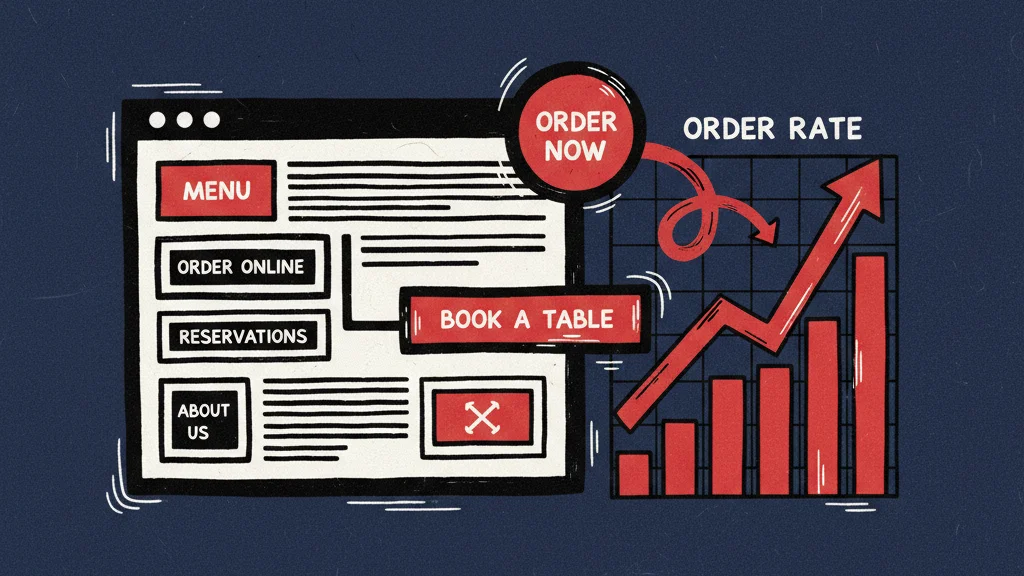
    Before getting into the mistakes, it helps to understand what conversion actually means here. Restaurant website conversion rate is the percentage of visitors who complete a desired action — placing an order, booking a reservation, or clicking through to your ordering system. Most restaurant websites convert at 1–2%. Optimized ones convert at 5–8%.

    That gap sounds abstract until you do the math. At 1,000 monthly visitors, a 1–2% conversion rate produces 10–20 orders per month. A 5–8% rate produces 50–80 orders per month from the same traffic. No new ads. No SEO push. Same visitors, radically different revenue — because the website is doing its job.

    These are the 7 mistakes that explain why most restaurant websites stay stuck at the low end.


    The 7 Restaurant Website Conversion Mistakes

    1. No “Order Now” Button Above the Fold on Mobile

    This is the single highest-impact conversion element on any restaurant website — and the most commonly botched one. Most restaurant websites bury the ordering option inside a menu dropdown, a navigation submenu, or a footer link. On desktop, that might be inconvenient. On mobile, it’s conversion-killing.

    More than 70% of restaurant website traffic comes from mobile devices. On a phone, “above the fold” means what’s visible on screen before the visitor scrolls at all. If your Order Now button requires scrolling, tapping a hamburger menu, finding a submenu, and tapping again — most visitors won’t do it. They’ll close the tab.

    The fix: A sticky header that keeps an Order Now button visible as the visitor scrolls, or a hero section where Order Now is the primary, prominently sized CTA on first load. The button should be impossible to miss and require exactly one tap to reach your ordering flow.

    2. Slow Mobile Load Time

    Visitors abandon pages that take more than 3 seconds to load. That’s not an opinion — it’s a consistently documented behavior across billions of sessions. At 6 seconds, you’ve already lost more than half your visitors before they’ve seen a single menu item.

    Most restaurant websites on standard SaaS platforms and website builders load in 5–8 seconds on mobile. Unoptimized images, bloated themes, third-party scripts, and hosting infrastructure that wasn’t designed for performance all compound. The result: the majority of your visitors never actually experience your website. They see a white screen and leave.

    The fix: Move to a platform built to deliver sub-2-second mobile load times. A PageSpeed score of 90 or higher on mobile is achievable and directly measurable. If your current platform can’t hit it, that platform is costing you orders every day.

    3. Ordering Link Goes to a Third-Party App

    When a visitor clicks “Order Online” on your website and lands on DoorDash or Uber Eats, two damaging things happen simultaneously. First, you pay 27–30% commission on every order that comes through that click — even though the visitor found you through your own website. Second, the visitor is now inside a third-party platform where your competitors are one scroll away, where their loyalty points accumulate for the platform rather than for you, and where your brand identity disappears entirely.

    Sending your own website visitors to a delivery app is one of the most expensive mistakes a restaurant can make. You’ve paid (in time, in cost, in SEO effort) to get that visitor to your site — and then you hand them to a platform that charges you to get them back.

    The fix: Your Order Now CTA should go directly to your own ordering page. If you want to give visitors the option to order through a platform, keep those links clearly secondary — smaller, lower on the page, labeled as alternatives rather than featured as the primary path.

    4. Menu Is a PDF

    PDF menus are a conversion problem on four levels. They don’t display cleanly on mobile — visitors zoom in, scroll awkwardly, lose their place, and bounce. They can’t be indexed properly by search engines, so they don’t contribute to SEO. They don’t support direct ordering — a visitor reading a PDF can’t tap an item and add it to a cart. And they load slowly, especially on mobile connections.

    Many restaurants use PDFs because they’re easy to update. That convenience costs more than it saves. A visitor who hits a PDF menu on mobile is likely to close the tab and search elsewhere.

    The fix: Replace the PDF with an HTML menu page or an integrated ordering menu. An HTML menu can be designed to match your brand, loads fast, is readable on any screen size, is indexable by Google, and can link directly into your ordering flow. It solves a conversion problem and an SEO problem at the same time.

    5. No Social Proof Visible on the Homepage

    A visitor landing on your restaurant’s homepage for the first time knows nothing about you. They’re making a judgment call in a few seconds: Is this place worth ordering from? If your homepage has no reviews, no photos of real food, and no signal that other people have ordered here and been happy — you’re asking them to take a leap of faith. Most won’t.

    Social proof is what bridges the gap between “browsing” and “buying.” It’s not a nice-to-have feature. It’s a core conversion mechanism. Restaurants with visible reviews and ratings on their homepage consistently convert at higher rates than those without — because confirmation reduces hesitation.

    The fix: Pull 3–5 Google review quotes directly onto the homepage. Display your star rating with the review count. Add a “most ordered” or “customer favorite” label to your top menu items. These elements cost nothing to add and meaningfully increase the confidence of first-time visitors.

    6. Contact Page Instead of Ordering CTA

    Many restaurant websites have a prominent “Contact Us” link in the main navigation but bury or omit the ordering CTA entirely. The problem is that visitor intent and website structure are completely misaligned. Someone landing on your restaurant website to place an order isn’t looking to contact anyone. They’re looking for a button that starts the ordering process.

    When the primary CTA across your site is Contact rather than Order, you’re optimizing for the wrong action. Visitors who want to order don’t fill out contact forms. They leave.

    The fix: Audit every page of your website and ask: what’s the most prominent action available to the visitor right now? If the answer is Contact, Email, or anything other than Order Now (or Reserve, for reservation-driven concepts), you have a CTA misalignment problem. Fix the navigation, the hero sections, and the page footers to make ordering the primary offered action throughout the site.

    7. No Incentive for Direct Ordering

    If a visitor is already comfortable ordering from DoorDash or Uber Eats, your website needs to give them a specific reason to switch. “Order on our website” is not a compelling offer. It’s a request with no benefit attached. Without a visible incentive, the path of least resistance is always the platform they already know.

    Direct ordering can and should be presented as the better deal — because for the customer, it often is. Free delivery, loyalty points, a discount on the first direct order, or a bundled offer exclusive to the website are all real advantages that platforms can’t match.

    The fix: Create a visible, specific incentive for direct ordering — and put it on the homepage and the ordering page where it can’t be missed. Order direct and get free delivery + loyalty points gives a visitor a concrete reason to act now and a reason to come back. That’s the foundation of converting a one-time visitor into a repeat direct customer.


    Find out which conversion mistakes your restaurant website is making.
    Free audit — checks mobile load time, above-fold CTA, ordering destination, menu format, and social proof in under 60 seconds.

    How to Audit Your Own Restaurant Website Conversion

    You don’t need a marketing agency to run a basic conversion audit. Pull up your website on a mobile phone and work through this checklist.

    • Mobile load time test: Open your website on your phone on a cellular connection (not WiFi) and count the seconds until it’s fully usable. If it’s more than 3 seconds, you have a load time problem. Confirm with PageSpeed Insights — a score below 70 on mobile is costing you visitors.
    • Above-fold CTA check: Load your homepage on a phone. Without scrolling or tapping anything, can you see an Order Now button? If not, that button needs to move up.
    • Ordering destination check: Tap your Order Now button (or equivalent). Where does it take you? If it opens DoorDash, Uber Eats, or any third-party platform, you’re losing margin on your own website traffic.
    • Menu format check: Open your menu. Is it a PDF? Does it require zooming or sideways scrolling to read on mobile? If yes, it needs to be rebuilt as an HTML page.
    • Social proof check: Look at your homepage without scrolling. Are there any review quotes, star ratings, or “customer favorite” labels visible? If not, your homepage isn’t building the confidence first-time visitors need.
    • Primary CTA audit: Scroll through your navigation and your main pages. Count how many times you see Order Now vs. Contact Us or other CTAs. Order Now should dominate.
    • Direct ordering incentive check: Is there a visible, specific benefit for ordering directly from your website rather than from a platform? If not, you’re not giving platform-habituated visitors a reason to change their behavior.

    If you found problems in three or more of these checks, your website conversion rate is almost certainly below 2%. The good news is that each of these is a fixable problem — not a traffic problem.


    What a Conversion-Optimized Restaurant Website Actually Looks Like

    It helps to have a concrete picture of what the optimized version looks like, particularly on mobile where the stakes are highest.

    A visitor opens your website on their phone. The page loads in under 2 seconds. The first thing they see is a full-width photo of your best-looking dish, your restaurant name, and a large, clearly labeled Order Now button. The header is sticky — as they scroll down, that Order Now button stays visible at the top of the screen.

    As they scroll, they see three review quotes pulled directly from Google — real names, real ratings, specific praise for the food. Below that, three top menu items with photos, prices, and a “Customer Favorite” badge. The items link directly into the ordering flow with one tap.

    At no point does tapping Order Now take them to DoorDash. At no point do they hit a PDF. At no point is Contact Us more prominent than the order CTA. The homepage has one job — moving a visitor from interested to ordering — and every element on it is there to serve that job.

    This isn’t a high-end custom build that takes months and costs a fortune. It’s a website built around conversion principles from the start, on a platform fast enough to deliver the experience without technical drag.


    How RichMenu Approaches Restaurant Website Conversion

    RichMenu builds restaurant websites engineered specifically for conversion. That means sub-1-second mobile load times, Order Now above the fold on first load, direct ordering integration that keeps commission dollars where they belong — with the restaurant — and social proof structured into the homepage by default.

    Every element described in this post is built into the RichMenu standard. The sticky Order Now header. The HTML menu. The Google review integration. The direct ordering flow. The incentive architecture for repeat direct customers. None of it is optional add-on configuration — it’s the baseline.

    For independent restaurant owners, the math is straightforward: the same 1,000 monthly visitors who currently generate 10–20 orders per month can generate 50–80 orders per month. The difference isn’t more traffic. It’s a website that converts.

    See how RichMenu builds conversion-optimized restaurant websites →


    Frequently Asked Questions

    What is a good conversion rate for a restaurant website?

    A good restaurant website conversion rate is 5–8%, measured as the percentage of visitors who place an order or complete the primary desired action. Most restaurant websites convert at 1–2%, which is the baseline for an unoptimized site. Reaching the 5–8% range typically requires fixing mobile load time, CTA placement, ordering integration, and social proof — not increasing traffic.

    Why is my restaurant website not getting orders?

    The most common reasons a restaurant website doesn’t generate orders are: the Order Now button isn’t visible on mobile without scrolling, the ordering link goes to a third-party platform, the mobile load time is too slow for visitors to stay, the menu is a PDF that doesn’t work on mobile, and there’s no social proof on the homepage to build ordering confidence. These are structural conversion problems, not traffic problems. Fixing them changes outcomes without requiring more visitors.

    How do I add online ordering to my restaurant website?

    The most conversion-effective approach is to integrate a direct ordering system so that visitors order through your website rather than being redirected to a third-party platform. Direct ordering systems eliminate the 27–30% commission charged by delivery apps on orders that originate from your own site. Platforms like RichMenu include direct ordering as a core feature, built into the website rather than linked externally.

    Does website speed affect restaurant orders?

    Yes — directly and measurably. Visitors abandon pages that take more than 3 seconds to load on mobile, and most restaurant websites take 5–8 seconds. At 6 seconds, more than half of visitors have already left before seeing a menu item. Improving mobile load time from 6 seconds to under 2 seconds typically produces one of the largest single conversion rate gains available to a restaurant website, because it stops visitor bleed before any other element of the site can do its job.

    Should my restaurant website ordering button go to DoorDash or my own system?

    Your primary Order Now button should go to your own direct ordering system, not to DoorDash or any third-party platform. When visitors who found you through your website order through DoorDash, you pay 27–30% commission on that order even though the visitor came to you directly. Beyond the cost, third-party platforms put your competitors one scroll away. Platform links can exist on your site as secondary options — but the featured, above-the-fold CTA should always drive to direct ordering.

    How do I get more orders from my restaurant website?

    Getting more orders from existing website traffic is a conversion optimization problem, not a traffic problem. The highest-impact changes are: moving Order Now above the fold on mobile, cutting mobile load time to under 2 seconds, switching the ordering destination from a third-party app to your own direct ordering system, replacing a PDF menu with an HTML menu, adding review quotes and star ratings to the homepage, and creating a visible incentive for direct ordering over platform ordering. Addressing all seven conversion mistakes outlined in this post can move a site from a 1–2% conversion rate to a 5–8% rate on the same traffic volume.

    Want a restaurant website built to convert visitors into orders?
    RichMenu builds fast, conversion-optimized restaurant websites — Order Now above the fold, sub-1-second mobile load, direct ordering integration, and social proof structured in from day one.


  • Restaurant Online Ordering Website: Your Own Site vs. Third-Party Apps (True Cost Comparison)

    Restaurant Online Ordering Website: Your Own Site vs. Third-Party Apps (True Cost Comparison)

    Every independent restaurant owner faces the same decision sooner or later: do you build direct ordering capability on your own website, or do you rely entirely on DoorDash, Uber Eats, and Grubhub to handle your takeout and delivery business? On the surface, the third-party path looks easy — no setup, instant access to millions of customers, someone else handles the logistics. But the economics tell a different story, and the hidden cost of handing over your customer relationships may be the most expensive decision you never realize you’re making.

    This guide breaks down the true cost of each model, shows you the exact math on when a direct restaurant online ordering website pays for itself, and explains how smart operators use both systems together to maximize revenue and build a customer base they actually own.


    How Restaurant Online Ordering Websites Work

    There are two fundamentally different models for taking orders online, and understanding the distinction is the foundation of every decision that follows.

    Model 1: Your Own Website with an Embedded Ordering System

    With this approach, you have a restaurant website — either built specifically for ordering or an existing site with an ordering widget embedded — and customers place orders directly with you. The ordering technology is provided by a flat-fee platform that integrates into your site. You own the URL, you own the customer data, and you pay a predictable monthly fee regardless of how many orders come through.

    Leading platforms in this category include:

    • ChowNow — monthly subscription, no per-order commission, strong marketing integrations
    • Flipdish — white-label ordering with loyalty and CRM tools built in
    • Toast Online Ordering — tight POS integration for restaurants already on Toast
    • Square Online — low barrier to entry, solid for smaller operations
    • SpotOn — full-stack restaurant platform with commission-free ordering included

    Monthly fees across these platforms typically range from $119 to $495 per month, depending on features and contract length. Commission: 0%.

    Model 2: Marketplace App Ordering

    DoorDash, Uber Eats, and Grubhub operate as consumer marketplaces. Customers discover your restaurant inside their app, place an order, and the platform handles payment processing and (for delivery orders) driver dispatch. The cost to you is a commission on every order — typically 25% to 30% of the subtotal, plus payment processing fees. There is no monthly fee, but there is no ceiling on what you pay either.


    The True Cost Comparison

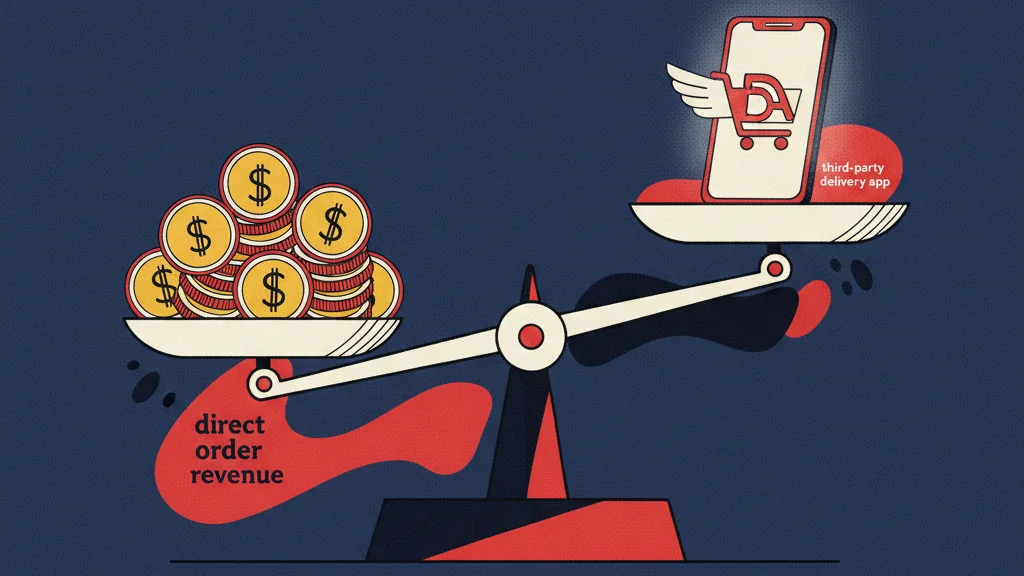
    The real question isn’t “which is cheaper to start” — third-party apps win that comparison at $0 setup. The real question is: at what point does a flat-fee direct ordering website cost less than paying 27% commission on every order?

    Break-Even Analysis

    Using a $495/month platform fee and a 27% blended commission rate:

    Break-even monthly order volume = $495 ÷ 0.27 = $1,833 in monthly orders

    If your restaurant does more than $1,833 per month in online orders — which most established restaurants do well before lunch on a Friday — the flat-fee model is already saving you money.

    Monthly Online Order Volume Third-Party Cost (27% commission) Direct Website Cost (flat $495/mo) Monthly Savings Annual Savings
    $1,833 $495 $495 $0 (break-even) $0
    $5,000 $1,350 $495 $855 $10,260
    $10,000 $2,700 $495 $2,205 $26,460
    $20,000 $5,400 $495 $4,905 $58,860

    A restaurant doing $10,000 a month in online orders — roughly $333 a day — pays $26,460 more per year on third-party apps than they would on a direct ordering website. That’s a dishwasher’s annual salary. That’s a kitchen renovation. That’s money that never needed to leave.

    Full Cost Comparison at a Glance

    Cost Factor Direct Ordering Website Third-Party Marketplace Apps
    Setup cost $0–$500 (design) $0
    Monthly platform fee $119–$495/month $0
    Per-order commission 0% 25–30%
    Payment processing ~2.6–2.9% (Stripe/Square) Included in commission
    Customer data ownership Yes — full access No — platform keeps it
    Menu control Full, instant updates Delayed, platform-dependent
    Delivery driver network Not included (add-on available) Yes, included
    Brand experience Fully branded Platform-branded

    What You Own With a Direct Ordering Website

    The commission math is compelling, but the ownership argument may matter even more in the long run. When a customer orders through your website, you receive:

    • Their name and email address — enabling direct communication, re-marketing, and loyalty programs
    • Their order history — so you know their preferences and can make targeted offers
    • Their phone number — for SMS campaigns with open rates over 90%
    • A direct relationship that isn’t intermediated by a platform whose interests may not align with yours

    With this data, you can run birthday promotions, lapsed-customer win-back campaigns, upsell campaigns when you introduce new menu items, and loyalty programs that reward your most valuable guests. None of this is possible when every order flows through a third-party app — they keep the customer data, and they use it to advertise your competitors to your own customers.

    Beyond data, you control pricing. Third-party apps often require menu parity clauses or impose pricing restrictions. On your own website, you set prices independently. You can run exclusive discounts for direct orders without triggering platform penalties. And if a platform changes its commission structure, fee terms, or visibility algorithm, it doesn’t affect your direct ordering channel at all.


    What Third-Party Apps Genuinely Provide That a Website Can’t

    This is an honest comparison, so the advantages of marketplace apps deserve acknowledgment.

    • Delivery driver network. DoorDash and Uber Eats maintain on-demand driver fleets. Unless you have your own drivers or add a delivery-as-a-service integration, your direct website handles pickup and catering orders more naturally than delivery.
    • Consumer marketplace discovery. Millions of people open these apps specifically to find somewhere to order from. If a customer doesn’t already know you exist, they won’t find your website — but they might find you on DoorDash. That discovery value is real.
    • Zero upfront investment for demand testing. If you’re a new restaurant or expanding to a new neighborhood, apps let you test delivery demand before committing to a direct ordering infrastructure.
    • Simplified operations for small volume. If you’re doing $500/month in online orders, the flat fee model hasn’t broken even yet. For very low-volume operations, apps remain cost-effective.

    The point isn’t to eliminate third-party apps. The point is to use them strategically — and stop letting them be your primary ordering channel once you’ve built a customer base.


    The Hybrid Model: Most Restaurants’ Optimal Answer

    The best-performing independent restaurants don’t choose between apps and their own website — they use both deliberately. The framework is simple: use apps for discovery, use your website for repeat orders.

    Think of a third-party app as a paid customer acquisition channel with a specific cost: 27% of that first order. Once a customer has ordered from you, you have their contact information (if you captured it through a loyalty program or email prompt at the counter), and every subsequent order they place on your website costs you 0% commission instead of 27%.

    The customer acquisition cost math works like this: if a customer places a $40 order through DoorDash, you pay roughly $10.80 in commission to acquire that customer relationship. If they become a repeat customer who orders 12 times a year at $40 each, you’ve acquired $480 in annual revenue for a one-time $10.80 acquisition cost — an effective customer acquisition cost (CAC) that most marketing channels would envy. The key is that orders 2 through 12 go through your website, not DoorDash.

    This is the hybrid model: aggressive on apps for new customer acquisition, disciplined about migrating repeat customers to your direct ordering channel as quickly as possible.


    How to Drive Orders to Your Website Instead of Apps

    Getting customers to order direct requires active effort. The following channels are the most effective for shifting volume:

    • Google Business Profile ordering link. Set your GBP ordering action URL to your direct ordering page. Customers searching your restaurant on Google will see the direct link before they ever open an app. This is the highest-leverage single change most restaurants can make.
    • Package inserts with QR codes. Every delivery bag and takeout container is a marketing touchpoint. A small card that reads “Order direct and save 10%” with a QR code linking to your website converts a third-party order into a direct customer.
    • Social media bio links. Instagram, Facebook, and TikTok bio links should point directly to your ordering page, not to your homepage or a DoorDash profile.
    • Email and SMS campaigns. If you’ve captured customer contacts, a simple “Order direct and skip the fees” campaign will convert a meaningful percentage to your website.
    • Direct-order incentives. Offer a permanent or recurring incentive — free dessert, 10% off, free delivery on orders over $30 — exclusive to customers who order through your website. Make the value proposition explicit.
    • In-restaurant table cards and receipts. Dine-in customers are warm prospects for future online orders. A QR code at the table drives them to your direct ordering page before they leave.

    What to Look for in a Restaurant Online Ordering Website

    Not all direct ordering platforms are created equal. When evaluating options, prioritize these factors:

    • Mobile page speed. More than 70% of restaurant online orders are placed on mobile. Pages that load in under one second convert dramatically better than slow ones. Look for platforms that host ordering pages on fast infrastructure, not bloated website builders.
    • Commission structure. Confirm it’s 0% commission or a flat fee — some platforms advertise “lower commissions” rather than zero, which is still a variable and ultimately unlimited cost.
    • POS integration. Orders should flow directly into your existing POS system to avoid manual re-entry and errors. Confirm compatibility before committing.
    • Menu management. You should be able to update items, prices, and availability in real time without waiting for platform support. Seasonal specials and 86’d items need to be manageable on the fly.
    • Customer data ownership. Confirm explicitly that you receive and retain full customer contact data. Some platforms capture this data but don’t export it or restrict how you use it.
    • Direct marketing capability. The platform should either provide email/SMS tools or allow clean data export to your own marketing platform.
    • Google Business Profile integration. The platform should support linking your GBP ordering action directly to your ordering page — this is table stakes for organic discoverability.

    How RichMenu Builds Your Direct Ordering Infrastructure

    RichMenu builds the complete direct ordering stack for independent restaurants — everything required to shift meaningful order volume away from commission-based apps and onto a channel you own and control.

    The RichMenu setup includes a fast, mobile-optimized restaurant website with ordering integration built in, not bolted on. Pages load quickly, the ordering flow is streamlined for mobile conversion, and the entire experience carries your brand — not a platform’s.

    Beyond the website itself, RichMenu connects your Google Business Profile ordering link directly to your ordering page, so customers who find you through Google search land on a direct ordering experience before they ever consider opening a third-party app. That single integration consistently represents the highest-volume source of direct orders for restaurants in the RichMenu network.

    Customer data from every order is yours. RichMenu doesn’t retain, resell, or market to your customers. You receive complete order history and contact data, which integrates with the marketing and loyalty tools you choose to use.

    For restaurants already running on third-party apps, RichMenu is designed to work alongside that existing revenue while systematically growing the commission-free share. The hybrid model, executed properly, means you stop losing ground to platform fees with every order your regulars place.

    See how RichMenu builds direct ordering websites for restaurants →


    Frequently Asked Questions

    What is a restaurant online ordering website?

    A restaurant online ordering website is a website — either standalone or an existing restaurant site with ordering functionality embedded — that allows customers to place food orders directly with the restaurant, without going through a third-party marketplace like DoorDash or Uber Eats. The restaurant owns the website, receives customer data from every order, and typically pays a flat monthly fee rather than a per-order commission. It is distinct from a marketplace listing in that the restaurant controls the brand experience, pricing, and customer relationship entirely.

    How much does it cost to set up online ordering on your own website?

    Setup costs for a direct ordering website range from essentially $0 (if you use a platform that handles design and setup as part of onboarding) to $300–$500 for custom design work. The ongoing cost is a monthly platform fee, typically between $119 and $495 per month depending on the platform and feature tier. Because there is no per-order commission, total cost is predictable and capped — unlike third-party apps, where costs scale indefinitely with order volume.

    Can a restaurant website replace DoorDash?

    A restaurant website can replace DoorDash as your primary ordering channel for repeat customers and pickup orders, but it does not replicate DoorDash’s delivery driver network or consumer discovery marketplace. Most operators find the most effective approach is a hybrid model: maintain a presence on DoorDash and Uber Eats for new customer discovery, while actively driving repeat customers to order direct. This approach captures the marketing value of the apps while eliminating ongoing commissions from your most loyal customers.

    What’s the best online ordering system for restaurants?

    The best system depends on your existing POS, order volume, and whether you need delivery driver integration. For commission-free direct ordering, ChowNow, Flipdish, Toast Online Ordering, Square Online, and SpotOn are the most commonly used platforms among independent restaurants. The most important factors to evaluate are mobile page speed, 0% commission structure, POS integration, and confirmed customer data ownership. RichMenu offers a complete direct ordering website build that includes Google Business Profile integration optimized for driving organic direct orders.

    How do customers find my restaurant website to order?

    Customers find your direct ordering website through several channels: Google search (especially if your Google Business Profile ordering link points to your site), social media bio links, QR codes on packaging and in-restaurant materials, and email or SMS campaigns to past customers. The Google Business Profile ordering link is typically the highest-volume single driver of direct orders — when customers search your restaurant name on Google Maps or Google Search, the direct ordering link appears prominently. Active promotion through packaging inserts and social media accelerates the shift from app-based to direct ordering.

    Do I need a separate app for restaurant online ordering?

    No — most restaurants do not need or benefit from a dedicated mobile app for online ordering. Mobile-optimized ordering websites convert comparably to native apps for restaurant ordering, without the significant development cost ($15,000–$50,000+) or the friction of asking customers to download and install a separate application. A fast, mobile-optimized ordering website accessible through a browser handles the vast majority of direct ordering needs effectively. Native apps make more sense for large chains with high-frequency repeat customers and substantial marketing budgets to drive app downloads.

    Want a direct ordering website that shifts repeat customers off the apps?
    RichMenu builds fast, commission-free restaurant websites with ordering integration, Google Maps ordering link, and customer data ownership built in from day one.


  • Delivery App True Cost: What DoorDash, Uber Eats & Grubhub Fees Really Cost Your Restaurant

    Delivery App True Cost: What DoorDash, Uber Eats & Grubhub Fees Really Cost Your Restaurant

    Every restaurant owner using DoorDash, Uber Eats, or Grubhub knows something feels wrong about the economics. You’re doing the cooking. You’re paying the staff. You’re buying the ingredients. And somewhere between 15% and 30% of every order — sometimes more — leaves your business before you’ve even covered your costs.

    The platforms make the fee structure intentionally difficult to total. Commission percentages, payment processing fees, marketing fees for better placement, delivery fee subsidies during promotions — each charge is framed separately, in different parts of the dashboard, in different reports. Most restaurant owners know roughly what they’re paying but haven’t sat down to calculate what that number is per year, at their actual order volume.

    This post does that math. Transparently, specifically, and at multiple order volumes — so you can see exactly what delivery app fees are costing your restaurant and what those dollars represent as a share of your actual margin.


    How Delivery App Fee Structures Actually Work

    The headline commission rate is not the complete cost. Here’s what you’re actually paying:

    Commission on order subtotal

    The primary fee — charged as a percentage of the food order value (before tax and tip). Current rates:

    • DoorDash: Basic plan 15%, Plus plan 25%, Premier plan 30%. Most restaurants are on Plus or Premier to access delivery and marketing features.
    • Uber Eats: 15–30% depending on plan, market, and negotiated rate. Most independent restaurants pay 27–30%.
    • Grubhub: 5–20% commission plus mandatory marketing fee of 10–20% if you want your restaurant to appear in search results. Effective rate: 15–30%.

    Payment processing fee

    Charged on top of commission — typically 2.9–3% of the transaction. On a $50 order already paying 25% commission, this adds another $1.45. It’s small per order and significant annually.

    Marketing and placement fees

    Paying commission doesn’t get you visibility in search results — that’s a separate cost. DoorDash’s “Sponsored Listings,” Uber Eats’ “Ads,” and Grubhub’s mandatory marketing fee (built into their plans) all add percentage points on top of base commission. Restaurants that opt out of these programs typically see significant drops in order volume — which is how the platforms ensure participation.

    Delivery fee subsidies

    During DashPass promotions and platform-wide deals, platforms sometimes reduce delivery fees for consumers and pass part of the cost to restaurants. This appears in your reports as a “promotion charge” and is easy to miss.

    Tablet and equipment fees

    Smaller but real — DoorDash and Uber Eats tablet fees ($6–$25/month each), equipment costs, and integration fees if you’re connecting to a POS system.


    The Real Annual Cost: What Delivery App Fees Add Up To

    Using a blended effective rate of 27% (commission + processing + placement — the realistic all-in rate for most independent restaurants on DoorDash or Uber Eats):

    Monthly Platform Orders Monthly Fees (27%) Annual Fees At 5% Net Margin, Equivalent to Losing…
    $5,000/month $1,350/month $16,200/year $324,000 in revenue
    $10,000/month $2,700/month $32,400/year $648,000 in revenue
    $20,000/month $5,400/month $64,800/year $1.3M in revenue
    $40,000/month $10,800/month $129,600/year $2.6M in revenue
    $75,000/month $20,250/month $243,000/year $4.9M in revenue

    The “equivalent revenue” column uses the industry average net margin of 5%. At 5% net margin, you need to generate $20 in revenue to net $1. When you pay $16,200 in platform fees, recovering that in net income requires generating an additional $324,000 in revenue. Most restaurants would need years to grow their way to that number — it would take one competent direct ordering strategy to eliminate it instead.

    And this is before accounting for what those platforms don’t give you in return.


    What Delivery App Fees Buy — and What They Don’t

    What you’re paying for

    • Discovery: New customers who find you through the platform’s marketplace and order for the first time
    • Logistics: Driver network, delivery tracking, and customer support for delivery orders
    • Order management: The tablet interface, order routing to kitchen, and basic analytics

    What you’re not getting

    • Customer data: You don’t know who ordered. The platform owns the customer’s name, email, order history, and contact information. You can’t re-market to them, build a loyalty relationship, or reach them when you have a promotion.
    • Repeat order economics: When a customer who already knows your restaurant orders through DoorDash, you pay 27% for an order you didn’t need the platform to generate. That’s loyalty revenue being taxed by a middleman.
    • Brand control: The customer experience — app design, driver interaction, packaging handling — is controlled by the platform. Your restaurant’s brand is secondary to the platform’s interface.
    • Pricing control: Many platforms require or pressure restaurants to maintain the same prices as in-store. Some restaurants raise menu prices on platforms to compensate, which creates inconsistent brand perception.

    The fundamental economic problem: delivery platforms charge the same 27% whether they introduced you to a brand-new customer (genuine value) or whether a loyal regular who’s ordered from you 20 times decided to use the app for convenience (no incremental value). The fee is indiscriminate. The value isn’t.


    The Repeat Customer Math: What You’re Paying for Orders You Already Earned

    Research consistently shows that 60–75% of delivery app orders come from customers who already know the restaurant — they searched by name, they reordered, they chose based on a previous experience. These are not discovery orders. These are loyalty orders being processed through a platform that charges discovery rates.

    At a restaurant doing $20,000/month in platform orders:

    • 60–75% repeat customers = $12,000–$15,000/month in orders from people who already know you
    • At 27% commission = $3,240–$4,050/month in fees on orders you didn’t need the platform to generate
    • Annually = $38,880–$48,600/year paid to platforms for repeat customer orders

    This is the most recoverable portion of platform fees. Repeat customers order directly when given a frictionless way to do it — which is a well-designed, fast-loading restaurant website with a commission-free ordering integration.


    The Direct Ordering Alternative: What Shifting 40% of Orders Is Worth

    You don’t need to eliminate delivery platforms to materially change your economics. Shifting a portion of repeat-customer orders to direct changes the math significantly.

    Monthly Platform Orders 40% Shifted to Direct Annual Recovery (at 27% avg) Net after $495/mo direct ordering costs
    $10,000 $4,000 direct $12,960/year saved $7,020/year net recovered
    $20,000 $8,000 direct $25,920/year saved $19,980/year net recovered
    $40,000 $16,000 direct $51,840/year saved $45,900/year net recovered
    $75,000 $30,000 direct $97,200/year saved $91,260/year net recovered

    These figures assume a $495/month direct ordering website management cost and 0% commission on direct orders. The net recovery at even modest order volumes makes the investment straightforward to justify.


    See exactly what delivery app fees are costing your restaurant.
    Free audit — checks your website’s direct ordering setup, Google ordering link, and commission recovery opportunities.

    How to Shift Repeat Customers to Direct Ordering

    The mechanics are simple. Execution requires consistency:

    Package insert with every delivery order

    A card or sticker in every bag: “Order direct at [your website] and get [incentive — a free item, loyalty points, a small discount]. Skip the app, support us directly.” QR code that goes straight to your ordering page. This converts every platform delivery into a direct ordering acquisition opportunity.

    Update your Google Business Profile ordering link

    The “Order Online” button on your Google Maps listing defaults to a delivery platform if you let it. Change it to your direct ordering page. Every customer who finds you on Google Maps and wants to order is routed to your website instead of DoorDash — commission-free.

    Add direct ordering to your Instagram and Facebook bio

    Your social media following is your warmest audience. Replace the DoorDash link in your bio with your direct ordering URL. Anyone motivated enough to check your social profile is motivated enough to order directly.

    Text or email existing customer list

    If you have any customer contact information — from a loyalty program, reservations, or past direct orders — a single campaign announcing direct ordering with a first-order incentive converts a meaningful portion immediately.

    Train staff to mention direct ordering

    For restaurants with takeout windows or phone orders: staff mentioning “you can also order directly on our website and save [incentive]” converts a portion of every phone interaction into a direct ordering customer going forward.


    Should You Leave Delivery Platforms Entirely?

    For most restaurants: no — and a gradual shift strategy outperforms a cold exit.

    Delivery platforms do provide genuine discovery value for new customers. Leaving entirely means losing that channel, which is a real cost — particularly for restaurants in competitive markets where platform search drives meaningful first-time customer acquisition.

    The optimal strategy for most restaurants:

    • Stay on platforms for discovery — new customers finding you for the first time through marketplace search
    • Actively convert repeat customers to direct — package inserts, GBP ordering link, social media, email/SMS campaigns
    • Reduce platform marketing spend — once you have a strong direct ordering channel, reduce or eliminate paid placement within the platform
    • Use platform data to identify your most loyal platform customers — then target them specifically for direct ordering conversion

    This hybrid approach recovers the highest-margin portion of platform revenue (repeat customers) while maintaining the genuine discovery benefit that platforms provide.


    How RichMenu Builds the Infrastructure for Direct Ordering

    Every website RichMenu builds is engineered to make direct ordering the default channel for repeat customers:

    • Sub-1-second mobile load time — fast enough that customers don’t revert to the delivery app out of impatience
    • Commission-free ordering integration — 0% per-order commission through direct POS integration or flat-fee ordering platforms
    • Order Now as the primary homepage CTA — visible above the fold on mobile, one tap away from starting an order
    • Google Business Profile ordering link pointed at your direct page — capturing Maps traffic as commission-free orders
    • Customer data ownership — every direct order builds your customer database, enabling re-marketing and loyalty campaigns that platforms never allow

    The combined effect: a restaurant that shifts 40% of its platform orders to direct within 12 months of launch — recovering tens of thousands of dollars in annual commission that previously left with every order.

    See how RichMenu builds the direct ordering infrastructure for restaurants →


    Frequently Asked Questions

    How much does DoorDash charge restaurants per order?

    DoorDash charges restaurants 15–30% commission per order depending on plan: Basic (15%), Plus (25%), and Premier (30%). Most restaurants use Plus or Premier to access delivery services and marketing features. Add payment processing fees (2.9–3%) and optional placement/marketing costs and the effective all-in rate is typically 25–30% of order value for most independent restaurants.

    How much does Uber Eats charge restaurants in commission?

    Uber Eats charges 15–30% commission per order, with the rate depending on plan, market, and any negotiated rates for higher-volume restaurants. Most independent restaurants pay 27–30%. Like DoorDash, payment processing fees (2.9–3%) are charged on top of commission, and paid placement within the app is an additional cost.

    Is DoorDash worth it for restaurants?

    DoorDash is worth it for genuine new customer discovery — orders from customers who wouldn’t have found you otherwise. It’s not worth it for repeat customer orders, which typically represent 60–75% of platform volume and carry no incremental discovery value. The right approach for most restaurants is to maintain platform presence for discovery while actively converting repeat customers to direct ordering, which eliminates the 27%+ commission on loyalty revenue.

    How can restaurants reduce delivery app fees?

    The most effective strategies: build a direct ordering channel and convert repeat customers away from platforms (package inserts with QR codes, GBP ordering link updates, social media links to direct ordering); negotiate a lower commission tier with platforms if you have meaningful volume; reduce or eliminate paid placement fees within platforms once direct ordering is established; and stay on the lowest-tier plan that maintains acceptable order volume from each platform.

    What percentage do delivery apps take from restaurants?

    The all-in effective rate including commission, payment processing, and placement fees is typically 25–30% for most independent restaurants on DoorDash or Uber Eats. Grubhub’s structure includes a mandatory marketing fee that makes direct cost comparison complex, but effective rates are similarly in the 20–30% range. At 27% all-in, a restaurant doing $20,000/month in platform orders pays $64,800/year in platform fees.

    What is the best alternative to DoorDash for restaurants?

    For direct ordering, commission-free platforms include ChowNow ($119–$328/month flat fee, 0% commission), Flipdish, and direct ordering integrations built into POS systems like Toast, Square, and SpotOn. The flat monthly fee model replaces per-order commissions with a fixed cost — recovering commission fees at any meaningful order volume. Combining a direct ordering platform with a fast, well-optimized restaurant website is the infrastructure required to shift repeat customers away from third-party apps.

    Ready to stop paying 27% on orders you already earned?
    RichMenu builds the direct ordering infrastructure that shifts repeat customers off platforms — commission-free ordering, sub-1-second load time, and Google Maps ordering link pointed at your website.


  • Commission-Free Restaurant Ordering: The Math, the Strategy, and How to Keep More of Every Order

    Commission-Free Restaurant Ordering: The Math, the Strategy, and How to Keep More of Every Order

    Every time a customer orders your food through DoorDash, Uber Eats, or Grubhub, somewhere between 15% and 30% of that order value leaves your business permanently. Not as a marketing cost you can optimize. Not as a fixed expense you can budget around. As a per-order tax on your own customers, collected by a platform that owns the relationship, keeps the data, and can raise the rate whenever it chooses.

    For a restaurant doing $20,000 a month in third-party delivery, that’s $3,000–$6,000 per month — $36,000–$72,000 per year — going to platforms in exchange for orders that, in most cases, came from customers who already knew your restaurant and would have ordered directly if you’d given them a frictionless way to do it.

    Commission-free ordering is the alternative. It’s not a new idea, but in 2026 — with direct ordering infrastructure more accessible than ever, and restaurant margins tighter than ever — it’s one of the highest-ROI decisions a restaurant operator can make.


    The Real Cost of Third-Party Delivery Commissions

    Platform commission structures vary, but the range is consistently damaging for restaurants operating on standard industry margins:

    • DoorDash: 15–30% per order depending on plan and market
    • Uber Eats: 15–30% per order
    • Grubhub: 5–20% per order plus additional marketing fees

    Apply those rates to monthly order volume and the impact is immediate:

    Monthly Third-Party Orders At 20% Commission At 25% Commission Annual Loss
    $10,000/month $2,000/month $2,500/month $24,000–$30,000
    $20,000/month $4,000/month $5,000/month $48,000–$60,000
    $40,000/month $8,000/month $10,000/month $96,000–$120,000
    $75,000/month $15,000/month $18,750/month $180,000–$225,000

    These figures represent revenue that was earned — food was prepared, an order was fulfilled — but never reached the restaurant. At typical restaurant net margins of 3–9%, the commission on a single $50 order can wipe out the profit on three or four additional orders. You’re not just paying for customer acquisition. You’re paying for customers you already had.

    And that’s before accounting for the other costs layered on top: reduced menu prices platforms require in some markets, marketing fees for placement in search results within the app, and the data lock-in that keeps customer ordering history and contact information in the platform’s hands — not yours.


    What Commission-Free Ordering Actually Means

    Commission-free ordering means customers place orders directly through your restaurant’s website — not through a third-party marketplace. The order goes directly to your kitchen. The payment goes directly to your account. You keep 100% of the order value minus payment processing fees (typically 2.5–3%), and you own the customer relationship.

    This is different from reducing your reliance on delivery platforms. Commission-free ordering is specifically about building a direct ordering channel — your website, your customer, your data — that captures the order before it ever reaches a platform.

    In practice, it works like this: a customer searches for your restaurant, finds your website, and orders directly from an ordering system embedded in or linked from your site. No app download required. No platform account needed. The experience is as simple as ordering through DoorDash — but the economics are entirely different.


    The “But We Need the Discovery” Argument — and Why It Doesn’t Hold

    The most common objection to reducing platform dependence is discovery: delivery apps have millions of users, and appearing in their search results brings in customers who wouldn’t have found you otherwise.

    This is partially true — and worth taking seriously. But the math behind it rarely supports the commission rate being paid.

    Multiple studies of restaurant ordering behavior consistently find that 60–80% of delivery app orders come from customers who already know the restaurant. They searched for you by name, or selected you because they’ve ordered before, or because a friend recommended you. These are not discovery orders — they’re loyalty orders being taxed at 20–30% by a platform that contributed nothing to the customer relationship.

    The genuine discovery value of delivery platforms — new customers who found you through marketplace browsing — is real but smaller than the commission rate implies. A reasonable approach is to maintain a presence on delivery platforms for actual discovery while aggressively converting known customers to direct ordering. Every customer who shifts from platform to direct ordering is an immediate, permanent margin improvement.

    The conversion mechanism is simple: when customers receive their order, include a card with a direct ordering link and an incentive (a free item on their next direct order, a loyalty point bonus, a small discount). Most customers prefer the direct experience once they try it — there’s no app switching, no platform markup on menu prices, and the transaction is with the restaurant they already trust.


    The Direct Ordering Math: What Shifting 30% of Platform Orders Is Worth

    You don’t need to eliminate delivery platforms to recover meaningful margin. Shifting a portion of platform orders to direct is enough to make a significant difference.

    Here’s what a conservative 30% shift from platform to direct ordering looks like:

    Monthly Platform Orders 30% Shifted to Direct Monthly Recovery (at 22% avg commission) Annual Recovery
    $10,000 $3,000 direct $660/month $7,920/year
    $20,000 $6,000 direct $1,320/month $15,840/year
    $40,000 $12,000 direct $2,640/month $31,680/year
    $75,000 $22,500 direct $4,950/month $59,400/year

    This is pure margin recovery — no additional orders, no marketing spend, no operational change. The same food, the same customers, with the delivery channel removed from the middle of the transaction.

    For a restaurant with $40,000 in monthly third-party delivery volume, recovering 30% of that to direct ordering puts an additional $31,680 per year to the bottom line. At 5% net margins, that’s equivalent to generating $633,000 in additional revenue through growth alone. Margin recovery is almost always more efficient than revenue growth.


    How much are platform commissions costing your restaurant?
    Run a free audit to see your website’s ordering readiness — and what you’d recover by shifting even 30% of platform orders to direct.

    What You Need to Run Commission-Free Ordering

    Setting up direct ordering isn’t technically complex, but it requires the right infrastructure to work properly:

    A fast, mobile-optimized website

    Your direct ordering channel lives or dies on your website experience. If your site loads in 4 seconds on mobile, customers will abandon to DoorDash — where the app loads instantly and the experience is familiar. Commission-free ordering requires a website fast enough to compete with the delivery app experience. That means sub-1-second load times, seamless mobile navigation, and an ordering flow that doesn’t require multiple page loads or account creation friction.

    A commission-free ordering integration

    Several ordering platforms offer zero-commission direct ordering for a flat monthly fee: ChowNow ($119–$328/month), Flipdish, and direct integrations available through most major POS systems including Toast, Square, and SpotOn. The flat fee is recovered the moment you shift even a small number of orders from platform to direct — typically within the first week of launch for any restaurant with meaningful delivery volume.

    Customer conversion strategy

    The ordering infrastructure alone doesn’t move customers. You need a mechanism to convert platform customers to direct customers: packaging inserts with QR codes, text or email campaigns to your existing customer list, loyalty incentives for direct orders, and a Google Business Profile that links directly to your ordering page rather than to a delivery platform.

    POS integration

    Direct orders need to flow into your kitchen the same way platform orders do — ideally through your existing POS so staff don’t need to manage a separate tablet or workflow. Most commission-free ordering platforms integrate with major POS systems. This is a technical step that’s worth confirming before choosing an ordering platform, but it’s rarely a blocker.


    Commission-Free Ordering and Your Website: Why They’re Inseparable

    The single biggest lever for direct ordering conversion is your website — specifically, how fast it loads, how easy it is to navigate on mobile, and how prominently the ordering flow is featured.

    A restaurant with a slow, hard-to-navigate website will fail at direct ordering regardless of how good the ordering platform is. Customers who encounter friction — slow load, confusing menu layout, checkout that requires too many steps — will open DoorDash and place the same order in 30 seconds. The commission gets paid not because the customer preferred the platform, but because the platform delivered a better experience.

    This is why the direct ordering opportunity and the website performance opportunity are the same decision. A high-performance restaurant website — fast, mobile-optimized, with a clear ordering path — is the infrastructure that makes commission-free ordering viable at scale.


    How RichMenu Builds Commission-Free Ordering Infrastructure

    Every website RichMenu builds is designed from the ground up to support direct ordering as the primary revenue channel:

    • Sub-1-second mobile load times — fast enough to compete with the delivery app experience that customers are used to. No friction at the point where the ordering decision is made.
    • 0% commission ordering integration — RichMenu integrates with commission-free ordering platforms and POS-native direct ordering systems, embedding them seamlessly into the website experience
    • Prominent ordering CTAs throughout — every page of the site is designed to route high-intent visitors toward the ordering flow, not toward a third-party platform
    • Google Business Profile ordering link — your GBP “Order Online” button links to your direct ordering page, capturing the customers who find you through Google Maps before they ever reach a delivery platform
    • Menu schema markup — your menu is structured for Google and AI indexing, so searches for specific dishes or menu items lead to your site, not to a platform listing
    • Customer data ownership — every direct order builds your customer database. You own those email addresses, order histories, and preferences — not DoorDash.

    The result is a direct ordering channel that competes on experience, not just economics. When your website is as fast and frictionless as a delivery app, customers choose it — especially when they already know you.

    See how RichMenu builds commission-free ordering into your restaurant website →


    Frequently Asked Questions

    What is commission-free restaurant ordering?

    Commission-free restaurant ordering means customers place orders directly through your restaurant’s website rather than through a third-party delivery marketplace like DoorDash or Uber Eats. You pay only standard payment processing fees (typically 2.5–3%) rather than platform commissions of 15–30% per order. You own the customer relationship, the transaction data, and the full order revenue.

    How much money can a restaurant save with commission-free ordering?

    At a 22% average platform commission, a restaurant doing $20,000/month in delivery orders pays $4,400/month — $52,800/year — in platform fees. Shifting even 30% of those orders to direct ordering recovers $1,320/month or $15,840/year in pure margin, with no additional revenue growth required. For restaurants with higher delivery volume, the savings scale proportionally and are often the single largest margin improvement available without operational changes.

    Do I have to stop using DoorDash and Uber Eats to do commission-free ordering?

    No. The most effective approach for most restaurants is a hybrid strategy: maintain a presence on delivery platforms for genuine new-customer discovery while building a direct ordering channel that converts known customers away from platforms. Every order shifted from platform to direct is an immediate, permanent margin improvement — you don’t need to go all-in on direct to see meaningful financial impact.

    What ordering platforms offer commission-free restaurant ordering?

    Several platforms offer zero-commission direct ordering for a flat monthly fee: ChowNow ($119–$328/month), Flipdish, and direct ordering integrations built into major POS systems including Toast, Square, and SpotOn. The flat fee is typically recovered within days for any restaurant with meaningful delivery volume, making commission-free platforms a straightforward financial decision.

    Why do I need a fast website for commission-free ordering to work?

    Your direct ordering channel competes directly with the delivery app experience — which is fast, familiar, and frictionless. If your website loads slowly or is hard to navigate on mobile, customers will revert to the app. Commission-free ordering only works at scale if the website experience is good enough to win the comparison. That means sub-1-second load times, mobile-optimized layout, and a clear, fast ordering flow.

    How do I convert my DoorDash customers to order directly?

    The most effective conversion tactics: include a QR code card in every delivery bag linking to your direct ordering page with a first-order incentive (a free item or small discount); update your Google Business Profile “Order Online” button to point to your direct ordering page; and send a direct ordering campaign to any customer contact list you have. Most customers prefer ordering directly once they try it — the main barrier is awareness that the option exists.

    Stop paying 20–30% of every order to a platform that owns your customers.
    RichMenu builds the website and ordering infrastructure that makes direct ordering your default channel — not an afterthought.