
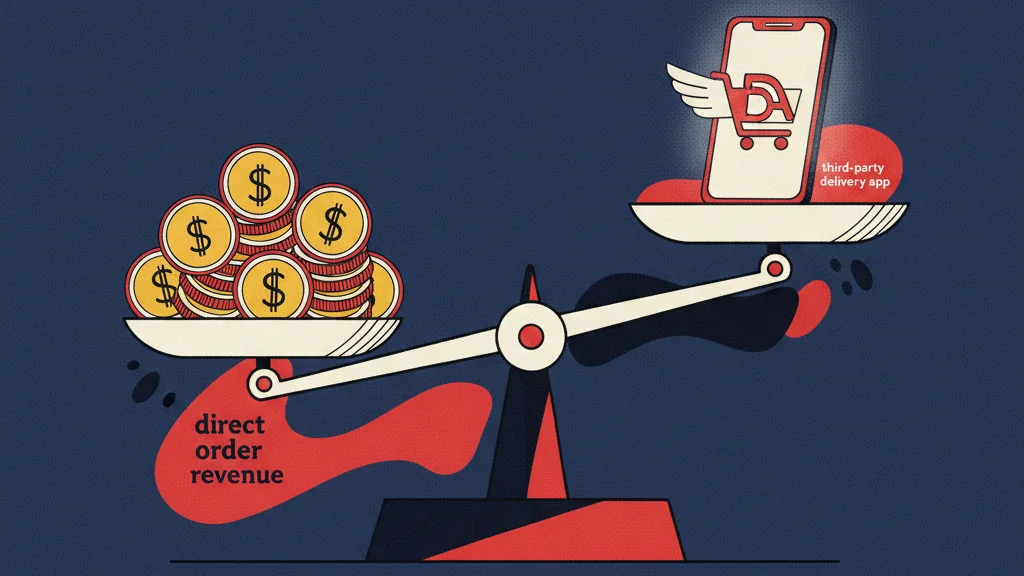
Every independent restaurant owner faces the same decision sooner or later: do you build direct ordering capability on your own website, or do you rely entirely on DoorDash, Uber Eats, and Grubhub to handle your takeout and delivery business? On the surface, the third-party path looks easy — no setup, instant access to millions of customers, someone else handles the logistics. But the economics tell a different story, and the hidden cost of handing over your customer relationships may be the most expensive decision you never realize you’re making.
This guide breaks down the true cost of each model, shows you the exact math on when a direct restaurant online ordering website pays for itself, and explains how smart operators use both systems together to maximize revenue and build a customer base they actually own.
How Restaurant Online Ordering Websites Work
There are two fundamentally different models for taking orders online, and understanding the distinction is the foundation of every decision that follows.
Model 1: Your Own Website with an Embedded Ordering System
With this approach, you have a restaurant website — either built specifically for ordering or an existing site with an ordering widget embedded — and customers place orders directly with you. The ordering technology is provided by a flat-fee platform that integrates into your site. You own the URL, you own the customer data, and you pay a predictable monthly fee regardless of how many orders come through.
Leading platforms in this category include:
- ChowNow — monthly subscription, no per-order commission, strong marketing integrations
- Flipdish — white-label ordering with loyalty and CRM tools built in
- Toast Online Ordering — tight POS integration for restaurants already on Toast
- Square Online — low barrier to entry, solid for smaller operations
- SpotOn — full-stack restaurant platform with commission-free ordering included
Monthly fees across these platforms typically range from $119 to $495 per month, depending on features and contract length. Commission: 0%.
Model 2: Marketplace App Ordering
DoorDash, Uber Eats, and Grubhub operate as consumer marketplaces. Customers discover your restaurant inside their app, place an order, and the platform handles payment processing and (for delivery orders) driver dispatch. The cost to you is a commission on every order — typically 25% to 30% of the subtotal, plus payment processing fees. There is no monthly fee, but there is no ceiling on what you pay either.
The True Cost Comparison
The real question isn’t “which is cheaper to start” — third-party apps win that comparison at $0 setup. The real question is: at what point does a flat-fee direct ordering website cost less than paying 27% commission on every order?
Break-Even Analysis
Using a $495/month platform fee and a 27% blended commission rate:
Break-even monthly order volume = $495 ÷ 0.27 = $1,833 in monthly orders
If your restaurant does more than $1,833 per month in online orders — which most established restaurants do well before lunch on a Friday — the flat-fee model is already saving you money.
| Monthly Online Order Volume | Third-Party Cost (27% commission) | Direct Website Cost (flat $495/mo) | Monthly Savings | Annual Savings |
|---|---|---|---|---|
| $1,833 | $495 | $495 | $0 (break-even) | $0 |
| $5,000 | $1,350 | $495 | $855 | $10,260 |
| $10,000 | $2,700 | $495 | $2,205 | $26,460 |
| $20,000 | $5,400 | $495 | $4,905 | $58,860 |
A restaurant doing $10,000 a month in online orders — roughly $333 a day — pays $26,460 more per year on third-party apps than they would on a direct ordering website. That’s a dishwasher’s annual salary. That’s a kitchen renovation. That’s money that never needed to leave.
Full Cost Comparison at a Glance
| Cost Factor | Direct Ordering Website | Third-Party Marketplace Apps |
|---|---|---|
| Setup cost | $0–$500 (design) | $0 |
| Monthly platform fee | $119–$495/month | $0 |
| Per-order commission | 0% | 25–30% |
| Payment processing | ~2.6–2.9% (Stripe/Square) | Included in commission |
| Customer data ownership | Yes — full access | No — platform keeps it |
| Menu control | Full, instant updates | Delayed, platform-dependent |
| Delivery driver network | Not included (add-on available) | Yes, included |
| Brand experience | Fully branded | Platform-branded |
What You Own With a Direct Ordering Website
The commission math is compelling, but the ownership argument may matter even more in the long run. When a customer orders through your website, you receive:
- Their name and email address — enabling direct communication, re-marketing, and loyalty programs
- Their order history — so you know their preferences and can make targeted offers
- Their phone number — for SMS campaigns with open rates over 90%
- A direct relationship that isn’t intermediated by a platform whose interests may not align with yours
With this data, you can run birthday promotions, lapsed-customer win-back campaigns, upsell campaigns when you introduce new menu items, and loyalty programs that reward your most valuable guests. None of this is possible when every order flows through a third-party app — they keep the customer data, and they use it to advertise your competitors to your own customers.
Beyond data, you control pricing. Third-party apps often require menu parity clauses or impose pricing restrictions. On your own website, you set prices independently. You can run exclusive discounts for direct orders without triggering platform penalties. And if a platform changes its commission structure, fee terms, or visibility algorithm, it doesn’t affect your direct ordering channel at all.
What Third-Party Apps Genuinely Provide That a Website Can’t
This is an honest comparison, so the advantages of marketplace apps deserve acknowledgment.
- Delivery driver network. DoorDash and Uber Eats maintain on-demand driver fleets. Unless you have your own drivers or add a delivery-as-a-service integration, your direct website handles pickup and catering orders more naturally than delivery.
- Consumer marketplace discovery. Millions of people open these apps specifically to find somewhere to order from. If a customer doesn’t already know you exist, they won’t find your website — but they might find you on DoorDash. That discovery value is real.
- Zero upfront investment for demand testing. If you’re a new restaurant or expanding to a new neighborhood, apps let you test delivery demand before committing to a direct ordering infrastructure.
- Simplified operations for small volume. If you’re doing $500/month in online orders, the flat fee model hasn’t broken even yet. For very low-volume operations, apps remain cost-effective.
The point isn’t to eliminate third-party apps. The point is to use them strategically — and stop letting them be your primary ordering channel once you’ve built a customer base.
The Hybrid Model: Most Restaurants’ Optimal Answer
The best-performing independent restaurants don’t choose between apps and their own website — they use both deliberately. The framework is simple: use apps for discovery, use your website for repeat orders.
Think of a third-party app as a paid customer acquisition channel with a specific cost: 27% of that first order. Once a customer has ordered from you, you have their contact information (if you captured it through a loyalty program or email prompt at the counter), and every subsequent order they place on your website costs you 0% commission instead of 27%.
The customer acquisition cost math works like this: if a customer places a $40 order through DoorDash, you pay roughly $10.80 in commission to acquire that customer relationship. If they become a repeat customer who orders 12 times a year at $40 each, you’ve acquired $480 in annual revenue for a one-time $10.80 acquisition cost — an effective customer acquisition cost (CAC) that most marketing channels would envy. The key is that orders 2 through 12 go through your website, not DoorDash.
This is the hybrid model: aggressive on apps for new customer acquisition, disciplined about migrating repeat customers to your direct ordering channel as quickly as possible.
How to Drive Orders to Your Website Instead of Apps
Getting customers to order direct requires active effort. The following channels are the most effective for shifting volume:
- Google Business Profile ordering link. Set your GBP ordering action URL to your direct ordering page. Customers searching your restaurant on Google will see the direct link before they ever open an app. This is the highest-leverage single change most restaurants can make.
- Package inserts with QR codes. Every delivery bag and takeout container is a marketing touchpoint. A small card that reads “Order direct and save 10%” with a QR code linking to your website converts a third-party order into a direct customer.
- Social media bio links. Instagram, Facebook, and TikTok bio links should point directly to your ordering page, not to your homepage or a DoorDash profile.
- Email and SMS campaigns. If you’ve captured customer contacts, a simple “Order direct and skip the fees” campaign will convert a meaningful percentage to your website.
- Direct-order incentives. Offer a permanent or recurring incentive — free dessert, 10% off, free delivery on orders over $30 — exclusive to customers who order through your website. Make the value proposition explicit.
- In-restaurant table cards and receipts. Dine-in customers are warm prospects for future online orders. A QR code at the table drives them to your direct ordering page before they leave.
What to Look for in a Restaurant Online Ordering Website
Not all direct ordering platforms are created equal. When evaluating options, prioritize these factors:
- Mobile page speed. More than 70% of restaurant online orders are placed on mobile. Pages that load in under one second convert dramatically better than slow ones. Look for platforms that host ordering pages on fast infrastructure, not bloated website builders.
- Commission structure. Confirm it’s 0% commission or a flat fee — some platforms advertise “lower commissions” rather than zero, which is still a variable and ultimately unlimited cost.
- POS integration. Orders should flow directly into your existing POS system to avoid manual re-entry and errors. Confirm compatibility before committing.
- Menu management. You should be able to update items, prices, and availability in real time without waiting for platform support. Seasonal specials and 86’d items need to be manageable on the fly.
- Customer data ownership. Confirm explicitly that you receive and retain full customer contact data. Some platforms capture this data but don’t export it or restrict how you use it.
- Direct marketing capability. The platform should either provide email/SMS tools or allow clean data export to your own marketing platform.
- Google Business Profile integration. The platform should support linking your GBP ordering action directly to your ordering page — this is table stakes for organic discoverability.
How RICHMENU Builds Your Direct Ordering Infrastructure
RICHMENU builds the complete direct ordering stack for independent restaurants — everything required to shift meaningful order volume away from commission-based apps and onto a channel you own and control.
The RICHMENU setup includes a fast, mobile-optimized restaurant website with ordering integration built in, not bolted on. Pages load quickly, the ordering flow is streamlined for mobile conversion, and the entire experience carries your brand — not a platform’s.
Beyond the website itself, RICHMENU connects your Google Business Profile ordering link directly to your ordering page, so customers who find you through Google search land on a direct ordering experience before they ever consider opening a third-party app. That single integration consistently represents the highest-volume source of direct orders for restaurants in the RICHMENU network.
Customer data from every order is yours. RICHMENU doesn’t retain, resell, or market to your customers. You receive complete order history and contact data, which integrates with the marketing and loyalty tools you choose to use.
For restaurants already running on third-party apps, RICHMENU is designed to work alongside that existing revenue while systematically growing the commission-free share. The hybrid model, executed properly, means you stop losing ground to platform fees with every order your regulars place.
See how RICHMENU builds direct ordering websites for restaurants →
Frequently Asked Questions
What is a restaurant online ordering website?
A restaurant online ordering website is a website — either standalone or an existing restaurant site with ordering functionality embedded — that allows customers to place food orders directly with the restaurant, without going through a third-party marketplace like DoorDash or Uber Eats. The restaurant owns the website, receives customer data from every order, and typically pays a flat monthly fee rather than a per-order commission. It is distinct from a marketplace listing in that the restaurant controls the brand experience, pricing, and customer relationship entirely.
How much does it cost to set up online ordering on your own website?
Setup costs for a direct ordering website range from essentially $0 (if you use a platform that handles design and setup as part of onboarding) to $300–$500 for custom design work. The ongoing cost is a monthly platform fee, typically between $119 and $495 per month depending on the platform and feature tier. Because there is no per-order commission, total cost is predictable and capped — unlike third-party apps, where costs scale indefinitely with order volume.
Can a restaurant website replace DoorDash?
A restaurant website can replace DoorDash as your primary ordering channel for repeat customers and pickup orders, but it does not replicate DoorDash’s delivery driver network or consumer discovery marketplace. Most operators find the most effective approach is a hybrid model: maintain a presence on DoorDash and Uber Eats for new customer discovery, while actively driving repeat customers to order direct. This approach captures the marketing value of the apps while eliminating ongoing commissions from your most loyal customers.
What’s the best online ordering system for restaurants?
The best system depends on your existing POS, order volume, and whether you need delivery driver integration. For commission-free direct ordering, ChowNow, Flipdish, Toast Online Ordering, Square Online, and SpotOn are the most commonly used platforms among independent restaurants. The most important factors to evaluate are mobile page speed, 0% commission structure, POS integration, and confirmed customer data ownership. RICHMENU offers a complete direct ordering website build that includes Google Business Profile integration optimized for driving organic direct orders.
How do customers find my restaurant website to order?
Customers find your direct ordering website through several channels: Google search (especially if your Google Business Profile ordering link points to your site), social media bio links, QR codes on packaging and in-restaurant materials, and email or SMS campaigns to past customers. The Google Business Profile ordering link is typically the highest-volume single driver of direct orders — when customers search your restaurant name on Google Maps or Google Search, the direct ordering link appears prominently. Active promotion through packaging inserts and social media accelerates the shift from app-based to direct ordering.
Do I need a separate app for restaurant online ordering?
No — most restaurants do not need or benefit from a dedicated mobile app for online ordering. Mobile-optimized ordering websites convert comparably to native apps for restaurant ordering, without the significant development cost ($15,000–$50,000+) or the friction of asking customers to download and install a separate application. A fast, mobile-optimized ordering website accessible through a browser handles the vast majority of direct ordering needs effectively. Native apps make more sense for large chains with high-frequency repeat customers and substantial marketing budgets to drive app downloads.