
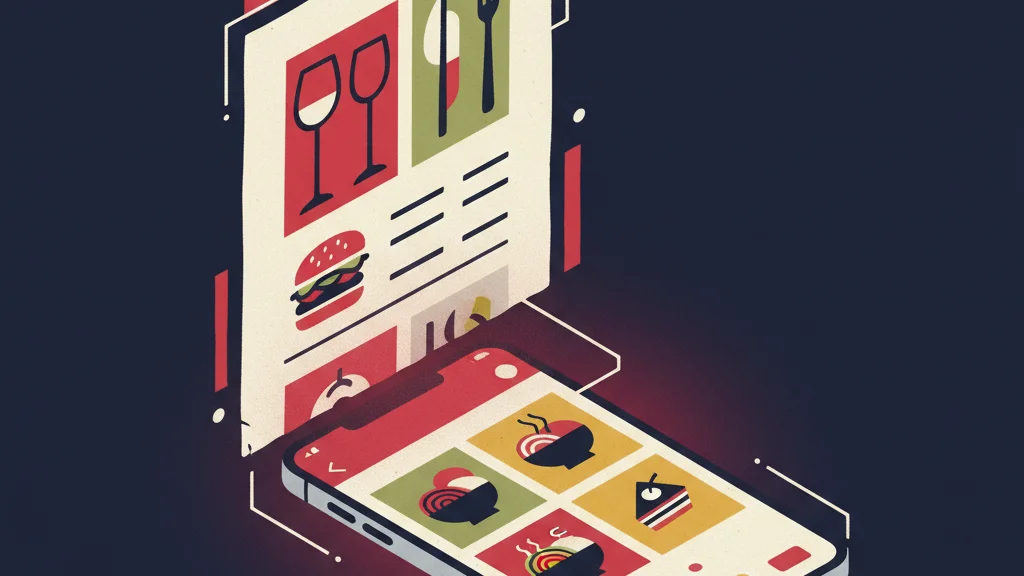
When someone searches for a restaurant online and lands on your website, the first thing they do is look for food. Not your story. Not your awards. Food. Photos of your actual dishes — what it looks like, how it’s plated, whether it’s the kind of meal they’re willing to pay for right now.
A rich menu for food is exactly what it sounds like: a menu experience that goes far beyond a list of items and prices. It’s visual, interactive, fast-loading, and built to convert a curious browser into a paying customer in under 60 seconds.
It’s also one of the highest-ROI investments a restaurant can make. The data is unambiguous: restaurants with rich, photo-driven menus see significantly more orders, higher average ticket sizes, and better Google rankings than those with text-only or PDF menus.
This guide explains what a rich food menu actually is, what separates a great one from a mediocre one, and what it takes to build a menu experience that performs the way your restaurant deserves.
What Is a RICHMENU for Food?
A rich menu is a digital menu experience that combines high-quality food photography, structured item descriptions, dietary and allergen information, and a seamless ordering flow — all optimized for mobile, search engines, and the AI tools increasingly driving restaurant discovery.
The opposite of a rich menu is a static one: a PDF upload, a scanned image, or a plain text list. These are invisible to search engines, frustrating on mobile, and psychologically ineffective — they give customers nothing to want.
A truly rich food menu does five things simultaneously:
- Makes food look irresistible
- Makes ordering frictionless
- Tells Google exactly what you serve
- Tells AI search tools exactly who you are
- Gets out of the way and lets the food sell itself
Why RICHMENUs Drive More Orders: The Data
This isn’t subjective. The impact of visual, rich menu experiences on restaurant revenue has been extensively studied — and the numbers are significant.
- Menus with food photos generate up to 44% more monthly sales compared to text-only menus.
- High-quality food photos increase total online orders by 35% on delivery platforms.
- 73% of customers actively want to see photos before ordering — making visual content a baseline expectation, not a bonus.
- 82% of people will order a dish based purely on how it looks in a photo — even if they had no prior intention of ordering that item.
- Food photos are 1.44x more important to diners than reading menu descriptions and 1.38x more important than reading reviews, according to a Google survey of 600 U.S. consumers.
- Restaurants that add photos to plain text menus report conversion rate increases of 25–30%.
The ROI math is straightforward: if professional food photos and a rich menu experience increase your online orders by just 20%, and you’re currently processing $25,000/month in online orders, that’s an additional $5,000/month — $60,000/year — from a one-time investment in your menu.
The 5 Elements That Make a Menu Truly Rich
Not all visual menus are created equal. Here’s what separates a genuinely rich menu experience from one that just has photos added to a basic template:
1. Professional Food Photography
Quality matters more than quantity here. Bad photos — dark, blurry, or poorly lit smartphone shots — are worse than no photos at all. They make your food look unappetizing and signal low quality to a customer making a split-second judgment.
A rich menu uses professional photography that captures your dishes at their best: accurate color, appealing plating, and consistent style across the menu. When every item looks like something worth ordering, your average check goes up.
2. Structured Descriptions That Sell and Search
Menu descriptions do double duty. For customers, they’re the sensory bridge between the photo and the decision to order — they evoke taste, texture, and satisfaction. For search engines and AI tools, they’re the data that determines whether your restaurant appears when someone searches “spicy tuna roll near me” or “best truffle pasta Chicago.”
Rich menus include descriptions that use the actual language customers search for — ingredient names, preparation styles, cuisine markers, and dietary qualifiers like gluten-free, vegan, or keto-friendly. This isn’t just good writing; it’s SEO embedded in your menu.
3. Dietary Tags, Filters, and Modifiers
Modern diners have dietary preferences, restrictions, and allergies that directly determine where they eat. A rich menu makes this information instantly scannable: icons for vegetarian, vegan, gluten-free, halal, spicy level, and common allergens.
Menus with filterable dietary tags also rank for specific search queries — “gluten-free pizza near me,” “vegan options [city]” — that text-heavy or PDF menus completely miss.
4. Seamless Mobile Ordering — On Your Domain
A rich menu isn’t just informational. It’s a conversion tool. That means the path from “this looks good” to “order placed” is as short as possible — ideally under five taps on a phone, without leaving your website, without creating an account, and without paying a commission to a third-party platform.
The moment your ordering flow redirects to DoorDash, Grubhub, or any third-party app, you’ve lost data ownership, surrendered 20–30% in commissions, and handed your customer relationship to a competitor. A truly rich menu keeps the entire transaction on your domain.
5. Schema Markup: Making Your Menu Readable by Machines
This is the element most restaurants don’t know about — and the one that separates a performant menu from one that’s invisible to search and AI.
Menu schema markup (part of the Schema.org standard) is structured code that tells Google, ChatGPT, Gemini, and other AI search tools exactly what your menu contains: item names, prices, descriptions, dietary attributes, and availability. Without it, machines guess — and often guess wrong, or don’t surface your restaurant at all.
With proper menu schema, your items can appear directly in Google search results as rich snippets. Your restaurant gets recommended by AI assistants with accurate information. And your visibility in the AI-driven search landscape — which is growing faster than traditional search — is locked in.
RICHMENU vs. Basic Menu: A Direct Comparison
| Feature | RICHMENU | Basic / PDF Menu |
|---|---|---|
| Food photography | Professional, per item | None or low quality |
| Mobile experience | Tap-friendly, fast-loading | Pinch/zoom PDF or plain list |
| Search engine visibility | Fully indexed, keyword-rich | Invisible to Google |
| AI search readiness | Schema-marked, machine-readable | Not detectable by AI tools |
| Dietary filters | Scannable icons and filters | Buried in text or absent |
| Online ordering | Direct, on your domain, 0% commission | Third-party redirect or none |
| Average order impact | +20–44% vs. text-only | Baseline |
| Data ownership | Full — you own customer data | Platform-owned or none |
What a RICHMENU Menu Delivers
RICHMENU was built specifically to deliver the richest, highest-converting menu experience available to independent and multi-location restaurants — on a foundation that you own outright.
Every RICHMENU website includes:
- Conversion-engineered menu design — layouts and UX flows tested specifically for restaurant ordering behavior, not adapted from generic ecommerce templates
- Full menu schema markup — every item, category, price, description, and dietary tag is machine-readable and AI-ready from launch day
- Integration with your preferred ordering platform — Zuppler, Toast, and other systems — so your menu drives orders without platform lock-in or commission drain
- 95–100 PageSpeed scores — so your menu loads before a customer’s patience runs out
- Mobile-first architecture — built for the phone screen first, because that’s where 70%+ of your visitors are
- Custom WordPress ownership — your menu, your data, your site. If you ever switch providers, you take everything with you
The results RICHMENU clients see aren’t theoretical. Restaurants on the platform have seen online orders increase by 22%, organic traffic grow by 35%, and load times cut from over 4 seconds to under 1 — all of which directly compound revenue over time.
See what a RICHMENU food menu looks like →
How to Get a RICHMENU for Your Restaurant
Getting a rich menu experience that performs across all five elements — photography, descriptions, mobile UX, ordering, and schema — requires more than a website plugin or a template update. Here’s the path:
- Audit your current menu. Is it a PDF? A plain text list? Does it have photos? Is it indexed by Google? Run it through the Restaurant Website Performance Grader to see your current score.
- Invest in food photography. Professional photos are the single highest-ROI upgrade you can make to a menu. Prioritize your top-selling items first, then expand.
- Rewrite descriptions for search. Include ingredient names, preparation methods, and cuisine markers. Think about what your customer types into Google at 6pm on a Friday.
- Move to a platform built for menus. If your menu lives in a PDF, a third-party app, or a basic website builder not designed for restaurants, it’s time to move. Your menu should live on your domain, in a format Google can read and customers can order from directly.
- Add schema markup. If your developer or platform doesn’t include this by default, it needs to be added. It’s non-negotiable for AI search visibility in 2026.
Or: skip the five-step rebuild and let RICHMENU handle all of it in 4–6 weeks.
Get a rich menu built for your restaurant →
Frequently Asked Questions
What is a rich menu for a restaurant?
A rich menu is a digital menu experience that combines professional food photography, keyword-rich descriptions, dietary filters, seamless mobile ordering, and schema markup — all optimized to convert website visitors into paying customers and to rank in both Google search and AI-powered search tools like ChatGPT and Gemini.
Do food photos really increase restaurant orders?
Yes — dramatically. Restaurants with professional food photos on their menus see 20–44% higher sales than those with text-only menus. On delivery platforms, food photos can increase orders by up to 70%. A Google survey found that customers consider photos 1.44x more important than menu descriptions when deciding where to order.
What is menu schema markup and does my restaurant need it?
Menu schema markup is structured code that makes your menu items machine-readable for Google, ChatGPT, Gemini, and other AI search tools. It tells them exactly what you serve, at what price, with what dietary attributes. Without it, AI tools can’t reliably recommend your restaurant. In 2026, menu schema is essential for AI search visibility — not optional.
What’s the difference between a rich menu and a regular digital menu?
A regular digital menu lists items and prices in a readable format. A rich menu goes further: it includes professional photography, structured and searchable descriptions, dietary filters, mobile-optimized UX, direct ordering integration, and full schema markup. The revenue difference between the two is measurable — typically 20–44% more orders.
Can I keep my current online ordering system with a rich menu?
Yes. A platform like RICHMENU integrates with your preferred ordering system — including Zuppler, Toast, and others — so you don’t have to change your operations to get a rich menu experience. The goal is to put the best possible front-end in front of your existing setup, not to force a platform switch.
How long does it take to build a rich menu for a restaurant?
With RICHMENU, a fully built, photographed, schema-marked, and conversion-optimized restaurant website with a rich menu experience launches in 4–6 weeks. The timeline includes design, menu build, ordering integration, SEO setup, and structured data implementation.