
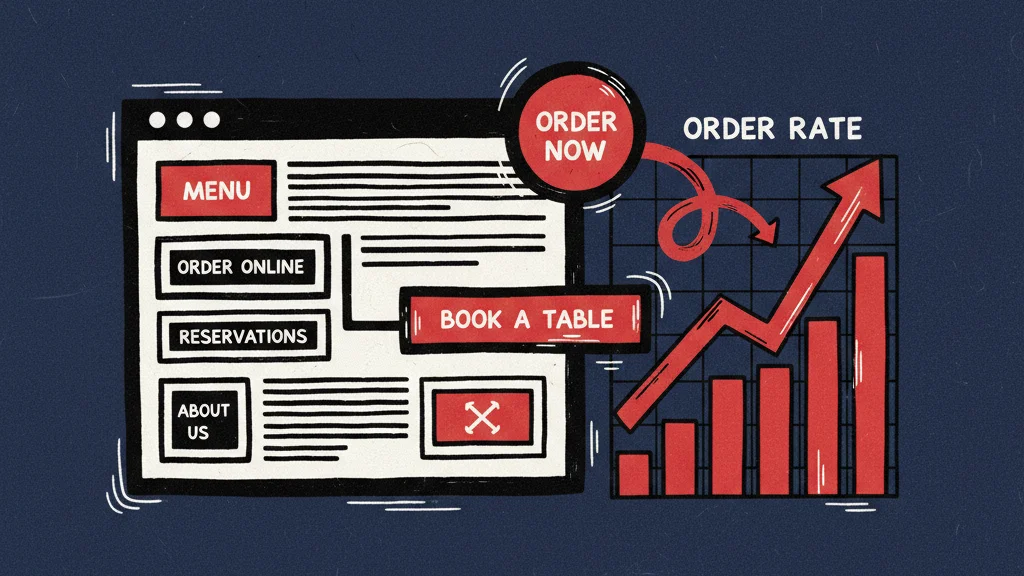
Most restaurant websites exist but don’t convert. Visitors land and leave without ordering. The gap between “we have a website” and “our website generates orders” is almost always explained by the same 7 mistakes — not by lack of traffic.
Before getting into the mistakes, it helps to understand what conversion actually means here. Restaurant website conversion rate is the percentage of visitors who complete a desired action — placing an order, booking a reservation, or clicking through to your ordering system. Most restaurant websites convert at 1–2%. Optimized ones convert at 5–8%.
That gap sounds abstract until you do the math. At 1,000 monthly visitors, a 1–2% conversion rate produces 10–20 orders per month. A 5–8% rate produces 50–80 orders per month from the same traffic. No new ads. No SEO push. Same visitors, radically different revenue — because the website is doing its job.
These are the 7 mistakes that explain why most restaurant websites stay stuck at the low end.
The 7 Restaurant Website Conversion Mistakes
1. No “Order Now” Button Above the Fold on Mobile
This is the single highest-impact conversion element on any restaurant website — and the most commonly botched one. Most restaurant websites bury the ordering option inside a menu dropdown, a navigation submenu, or a footer link. On desktop, that might be inconvenient. On mobile, it’s conversion-killing.
More than 70% of restaurant website traffic comes from mobile devices. On a phone, “above the fold” means what’s visible on screen before the visitor scrolls at all. If your Order Now button requires scrolling, tapping a hamburger menu, finding a submenu, and tapping again — most visitors won’t do it. They’ll close the tab.
The fix: A sticky header that keeps an Order Now button visible as the visitor scrolls, or a hero section where Order Now is the primary, prominently sized CTA on first load. The button should be impossible to miss and require exactly one tap to reach your ordering flow.
2. Slow Mobile Load Time
Visitors abandon pages that take more than 3 seconds to load. That’s not an opinion — it’s a consistently documented behavior across billions of sessions. At 6 seconds, you’ve already lost more than half your visitors before they’ve seen a single menu item.
Most restaurant websites on standard SaaS platforms and website builders load in 5–8 seconds on mobile. Unoptimized images, bloated themes, third-party scripts, and hosting infrastructure that wasn’t designed for performance all compound. The result: the majority of your visitors never actually experience your website. They see a white screen and leave.
The fix: Move to a platform built to deliver sub-2-second mobile load times. A PageSpeed score of 90 or higher on mobile is achievable and directly measurable. If your current platform can’t hit it, that platform is costing you orders every day.
3. Ordering Link Goes to a Third-Party App
When a visitor clicks “Order Online” on your website and lands on DoorDash or Uber Eats, two damaging things happen simultaneously. First, you pay 27–30% commission on every order that comes through that click — even though the visitor found you through your own website. Second, the visitor is now inside a third-party platform where your competitors are one scroll away, where their loyalty points accumulate for the platform rather than for you, and where your brand identity disappears entirely.
Sending your own website visitors to a delivery app is one of the most expensive mistakes a restaurant can make. You’ve paid (in time, in cost, in SEO effort) to get that visitor to your site — and then you hand them to a platform that charges you to get them back.
The fix: Your Order Now CTA should go directly to your own ordering page. If you want to give visitors the option to order through a platform, keep those links clearly secondary — smaller, lower on the page, labeled as alternatives rather than featured as the primary path.
4. Menu Is a PDF
PDF menus are a conversion problem on four levels. They don’t display cleanly on mobile — visitors zoom in, scroll awkwardly, lose their place, and bounce. They can’t be indexed properly by search engines, so they don’t contribute to SEO. They don’t support direct ordering — a visitor reading a PDF can’t tap an item and add it to a cart. And they load slowly, especially on mobile connections.
Many restaurants use PDFs because they’re easy to update. That convenience costs more than it saves. A visitor who hits a PDF menu on mobile is likely to close the tab and search elsewhere.
The fix: Replace the PDF with an HTML menu page or an integrated ordering menu. An HTML menu can be designed to match your brand, loads fast, is readable on any screen size, is indexable by Google, and can link directly into your ordering flow. It solves a conversion problem and an SEO problem at the same time.
5. No Social Proof Visible on the Homepage
A visitor landing on your restaurant’s homepage for the first time knows nothing about you. They’re making a judgment call in a few seconds: Is this place worth ordering from? If your homepage has no reviews, no photos of real food, and no signal that other people have ordered here and been happy — you’re asking them to take a leap of faith. Most won’t.
Social proof is what bridges the gap between “browsing” and “buying.” It’s not a nice-to-have feature. It’s a core conversion mechanism. Restaurants with visible reviews and ratings on their homepage consistently convert at higher rates than those without — because confirmation reduces hesitation.
The fix: Pull 3–5 Google review quotes directly onto the homepage. Display your star rating with the review count. Add a “most ordered” or “customer favorite” label to your top menu items. These elements cost nothing to add and meaningfully increase the confidence of first-time visitors.
6. Contact Page Instead of Ordering CTA
Many restaurant websites have a prominent “Contact Us” link in the main navigation but bury or omit the ordering CTA entirely. The problem is that visitor intent and website structure are completely misaligned. Someone landing on your restaurant website to place an order isn’t looking to contact anyone. They’re looking for a button that starts the ordering process.
When the primary CTA across your site is Contact rather than Order, you’re optimizing for the wrong action. Visitors who want to order don’t fill out contact forms. They leave.
The fix: Audit every page of your website and ask: what’s the most prominent action available to the visitor right now? If the answer is Contact, Email, or anything other than Order Now (or Reserve, for reservation-driven concepts), you have a CTA misalignment problem. Fix the navigation, the hero sections, and the page footers to make ordering the primary offered action throughout the site.
7. No Incentive for Direct Ordering
If a visitor is already comfortable ordering from DoorDash or Uber Eats, your website needs to give them a specific reason to switch. “Order on our website” is not a compelling offer. It’s a request with no benefit attached. Without a visible incentive, the path of least resistance is always the platform they already know.
Direct ordering can and should be presented as the better deal — because for the customer, it often is. Free delivery, loyalty points, a discount on the first direct order, or a bundled offer exclusive to the website are all real advantages that platforms can’t match.
The fix: Create a visible, specific incentive for direct ordering — and put it on the homepage and the ordering page where it can’t be missed. Order direct and get free delivery + loyalty points gives a visitor a concrete reason to act now and a reason to come back. That’s the foundation of converting a one-time visitor into a repeat direct customer.
How to Audit Your Own Restaurant Website Conversion
You don’t need a marketing agency to run a basic conversion audit. Pull up your website on a mobile phone and work through this checklist.
- Mobile load time test: Open your website on your phone on a cellular connection (not WiFi) and count the seconds until it’s fully usable. If it’s more than 3 seconds, you have a load time problem. Confirm with PageSpeed Insights — a score below 70 on mobile is costing you visitors.
- Above-fold CTA check: Load your homepage on a phone. Without scrolling or tapping anything, can you see an Order Now button? If not, that button needs to move up.
- Ordering destination check: Tap your Order Now button (or equivalent). Where does it take you? If it opens DoorDash, Uber Eats, or any third-party platform, you’re losing margin on your own website traffic.
- Menu format check: Open your menu. Is it a PDF? Does it require zooming or sideways scrolling to read on mobile? If yes, it needs to be rebuilt as an HTML page.
- Social proof check: Look at your homepage without scrolling. Are there any review quotes, star ratings, or “customer favorite” labels visible? If not, your homepage isn’t building the confidence first-time visitors need.
- Primary CTA audit: Scroll through your navigation and your main pages. Count how many times you see Order Now vs. Contact Us or other CTAs. Order Now should dominate.
- Direct ordering incentive check: Is there a visible, specific benefit for ordering directly from your website rather than from a platform? If not, you’re not giving platform-habituated visitors a reason to change their behavior.
If you found problems in three or more of these checks, your website conversion rate is almost certainly below 2%. The good news is that each of these is a fixable problem — not a traffic problem.
What a Conversion-Optimized Restaurant Website Actually Looks Like
It helps to have a concrete picture of what the optimized version looks like, particularly on mobile where the stakes are highest.
A visitor opens your website on their phone. The page loads in under 2 seconds. The first thing they see is a full-width photo of your best-looking dish, your restaurant name, and a large, clearly labeled Order Now button. The header is sticky — as they scroll down, that Order Now button stays visible at the top of the screen.
As they scroll, they see three review quotes pulled directly from Google — real names, real ratings, specific praise for the food. Below that, three top menu items with photos, prices, and a “Customer Favorite” badge. The items link directly into the ordering flow with one tap.
At no point does tapping Order Now take them to DoorDash. At no point do they hit a PDF. At no point is Contact Us more prominent than the order CTA. The homepage has one job — moving a visitor from interested to ordering — and every element on it is there to serve that job.
This isn’t a high-end custom build that takes months and costs a fortune. It’s a website built around conversion principles from the start, on a platform fast enough to deliver the experience without technical drag.
How RichMenu Approaches Restaurant Website Conversion
RichMenu builds restaurant websites engineered specifically for conversion. That means sub-1-second mobile load times, Order Now above the fold on first load, direct ordering integration that keeps commission dollars where they belong — with the restaurant — and social proof structured into the homepage by default.
Every element described in this post is built into the RichMenu standard. The sticky Order Now header. The HTML menu. The Google review integration. The direct ordering flow. The incentive architecture for repeat direct customers. None of it is optional add-on configuration — it’s the baseline.
For independent restaurant owners, the math is straightforward: the same 1,000 monthly visitors who currently generate 10–20 orders per month can generate 50–80 orders per month. The difference isn’t more traffic. It’s a website that converts.
See how RichMenu builds conversion-optimized restaurant websites →
Frequently Asked Questions
What is a good conversion rate for a restaurant website?
A good restaurant website conversion rate is 5–8%, measured as the percentage of visitors who place an order or complete the primary desired action. Most restaurant websites convert at 1–2%, which is the baseline for an unoptimized site. Reaching the 5–8% range typically requires fixing mobile load time, CTA placement, ordering integration, and social proof — not increasing traffic.
Why is my restaurant website not getting orders?
The most common reasons a restaurant website doesn’t generate orders are: the Order Now button isn’t visible on mobile without scrolling, the ordering link goes to a third-party platform, the mobile load time is too slow for visitors to stay, the menu is a PDF that doesn’t work on mobile, and there’s no social proof on the homepage to build ordering confidence. These are structural conversion problems, not traffic problems. Fixing them changes outcomes without requiring more visitors.
How do I add online ordering to my restaurant website?
The most conversion-effective approach is to integrate a direct ordering system so that visitors order through your website rather than being redirected to a third-party platform. Direct ordering systems eliminate the 27–30% commission charged by delivery apps on orders that originate from your own site. Platforms like RichMenu include direct ordering as a core feature, built into the website rather than linked externally.
Does website speed affect restaurant orders?
Yes — directly and measurably. Visitors abandon pages that take more than 3 seconds to load on mobile, and most restaurant websites take 5–8 seconds. At 6 seconds, more than half of visitors have already left before seeing a menu item. Improving mobile load time from 6 seconds to under 2 seconds typically produces one of the largest single conversion rate gains available to a restaurant website, because it stops visitor bleed before any other element of the site can do its job.
Should my restaurant website ordering button go to DoorDash or my own system?
Your primary Order Now button should go to your own direct ordering system, not to DoorDash or any third-party platform. When visitors who found you through your website order through DoorDash, you pay 27–30% commission on that order even though the visitor came to you directly. Beyond the cost, third-party platforms put your competitors one scroll away. Platform links can exist on your site as secondary options — but the featured, above-the-fold CTA should always drive to direct ordering.
How do I get more orders from my restaurant website?
Getting more orders from existing website traffic is a conversion optimization problem, not a traffic problem. The highest-impact changes are: moving Order Now above the fold on mobile, cutting mobile load time to under 2 seconds, switching the ordering destination from a third-party app to your own direct ordering system, replacing a PDF menu with an HTML menu, adding review quotes and star ratings to the homepage, and creating a visible incentive for direct ordering over platform ordering. Addressing all seven conversion mistakes outlined in this post can move a site from a 1–2% conversion rate to a 5–8% rate on the same traffic volume.